

Immigration New Zealand (INZ) has announced changes to how Expressions of Interest (EOIs) for the Parent Resident Visa are selected. The new policy takes effect on 5 October 2026.
Parent Resident Visa EOIs will no longer be selected purely by random ballot. Instead, most will be selected from a queue, with a smaller share still drawn by ballot. If you have already submitted an EOI and are waiting for a Parent Resident Visa, pay particular attention to your EOI's expiry date and the transitional arrangements.
01. The biggest change
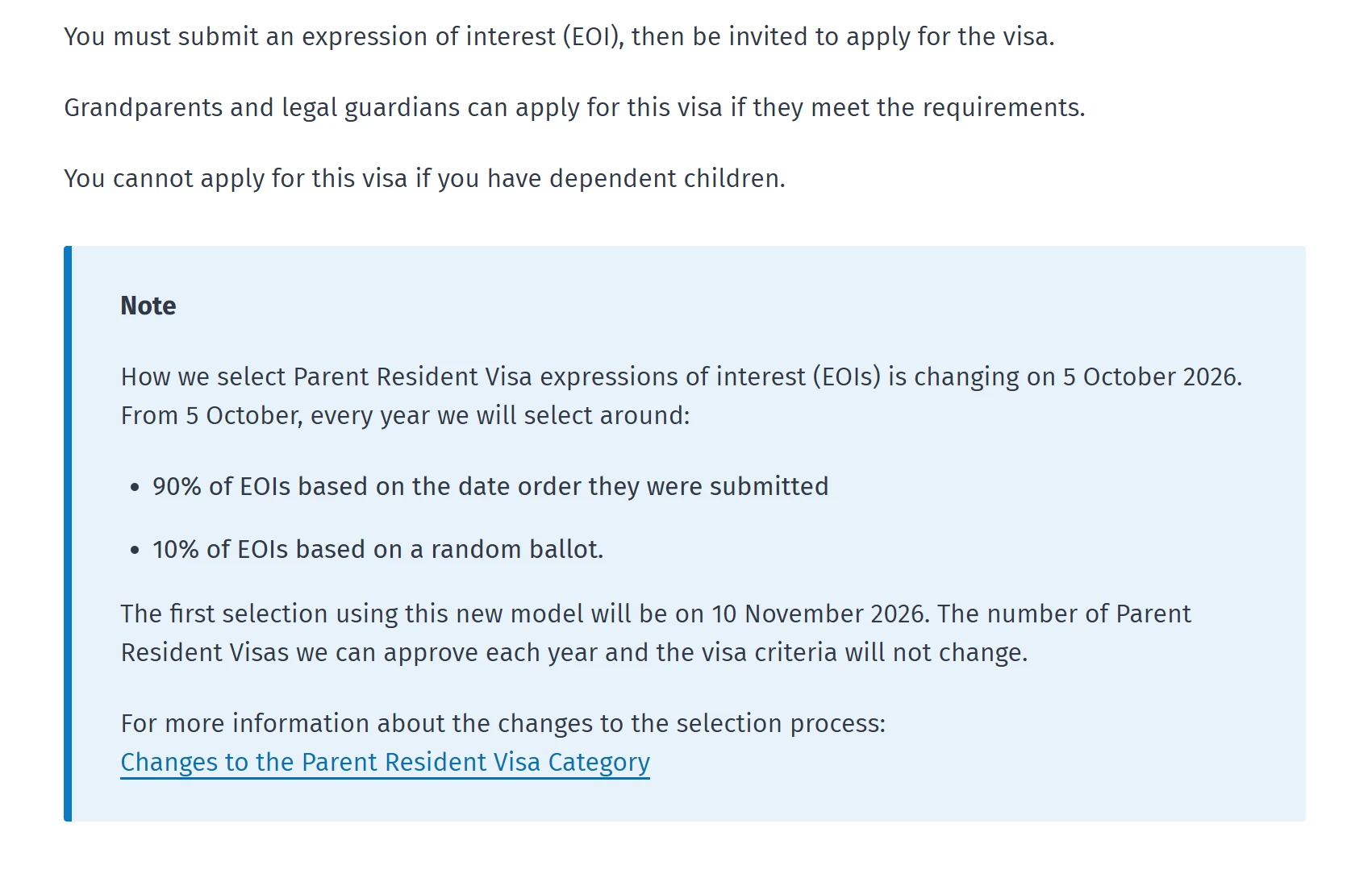
About 90% of each selection will come from the queue
From 5 October 2026, the Parent Category EOI pool will use a new selection system:
About 90% of the EOIs selected each time: taken from a queue in order of submission date.
The remaining 10% or so: still selected by random ballot.
At each selection, INZ will first select EOIs from the queue in date order and then run the random ballot. The Parent Resident Visa will move to a "mainly queue, partly ballot" selection model.
For applicants who have already been waiting in the Parent Category EOI system for years, the time they have waited may now count under the new queue system. The first selection under the new model will take place on 10 November 2026.
02. EOIs will no longer expire automatically every two years
This is the other major change. From 5 October 2026, EOIs in the new queue system will no longer expire automatically every two years.
That does not mean you can submit an EOI and forget about it. Once your EOI has been in the pool for two years, you need to contact INZ within 6 months after the second anniversary to confirm that you want to stay in the EOI pool.
If you do not confirm within that time, your EOI will expire and be removed from the pool. INZ will send reminder emails, so make sure your email address is up to date and check your spam folder.
03. No change to the annual quota
Annual quota: there are still 2,500 Parent Resident Visa places each year.
EOI selections: still expected to take place four times a year, in February, May, August and November.
The new selection system does not increase the annual number of resident visa places.
04. What to do if your EOI is about to expire
Situation 1: your EOI expires before 5 October 2026
If your EOI expires on or before Sunday 4 October 2026, take particular care. If your circumstances have not changed and you want to stay in the Parent Category EOI pool, you will need to submit a new EOI after the original one expires.
Pay close attention to when you submit the new EOI, as this may affect your place in the new queue.
Situation 2: your EOI does not expire before 5 October 2026
If you currently have a valid EOI that will not expire before 5 October, you do not need to resubmit it or contact INZ. Your existing EOI will be moved into the new Parent Category EOI pool.
After 5 October, INZ will email you with your new queue position and the next steps.
05. Important: the 90-day transitional rule
For applicants who previously submitted an EOI that has since expired, the policy includes an important 90-day transitional rule.
If your previous EOI expired before 5 October 2026 and you submit a new EOI within 90 days of the original EOI expiring, your queue position may still be based on the date you first submitted your EOI.
Original EOI expires → new EOI submitted within 90 days
You may keep your original queue date.
Original EOI expires → new EOI submitted after more than 90 days
Your queue position will usually be based on the new submission date.
This is especially important for applicants who have already been waiting a long time.
06. What if a couple's roles changed between EOIs?
INZ has specifically addressed this situation. For example, when the first EOI was submitted, A was the principal applicant and B the secondary applicant; when a later EOI was submitted, B became the principal applicant and A the secondary applicant.
In this case, as long as at least one applicant is the same across the EOIs, the transitional rule may still apply.
If you have submitted Parent Category EOIs more than once, carefully check:
- the date your first EOI was submitted;
- the expiry date of each EOI;
- the date your new EOI was submitted;
- the applicant details in each EOI;
- any changes between principal and secondary applicants.
All of these details may affect your future queue position.
07. What applicants should do now
1. Check your EOI expiry date
In particular, confirm whether your EOI will expire before 5 October 2026.
2. Check your email
Make sure the email address INZ has for you is correct and current, and check your spam folder regularly.
3. If you have an expired EOI, keep the 90-day rule in mind
If you want to keep the time you have already spent in the queue, pay close attention to when you resubmit after your EOI expires.
4. Update your details if your circumstances change
For example, if family members or the principal and secondary applicant roles change, check promptly whether your EOI needs to be updated.
08. What the reform means
Overall, Parent Resident Visa EOI selection is moving away from relying purely on a random ballot towards a "mainly queue, partly ballot" model. At each selection, about 90% of EOIs will come from the queue in date order and about 10% will still be selected by random ballot.
The change is particularly significant for applicants who have already been waiting a long time and meet the transitional rules. However, the annual quota of 2,500 resident visa places has not increased, so the new queue system does not mean applicants will be invited straight away.

A note from Leader
The Parent Resident Visa involves long waiting times and changes in family circumstances, and every family's EOI history is different. If your EOI is about to expire, you have submitted EOIs several times, or the principal and secondary applicants have changed, we recommend checking your EOI records early to confirm whether the new transitional arrangements apply to you.
If you have questions about your queue position, the 90-day rule or resubmitting your EOI, we recommend getting advice based on your own circumstances.